
Heavy-duty towing and recovery operations demand equipment capable of handling challenging loads, difficult recovery angles, and unpredictable job-site conditions. For towing companies investing in specialized recovery equipment, choosing the right rotator tow truck is an important decision that can influence operational capabilities, efficiency, and the types of recovery contracts they can pursue.
Two popular heavy-duty recovery configurations are the 35/40-ton rotator and the 50/60-ton rotator. Both offer substantial lifting power, rotating recovery booms, advanced stabilization systems, and versatile winching capabilities. However, their differences become especially important when working with overturned tractor-trailers, heavy commercial vehicles, and complex recovery situations.
Understanding these differences can help towing operators determine which class of rotator best fits their fleet and recovery requirements.
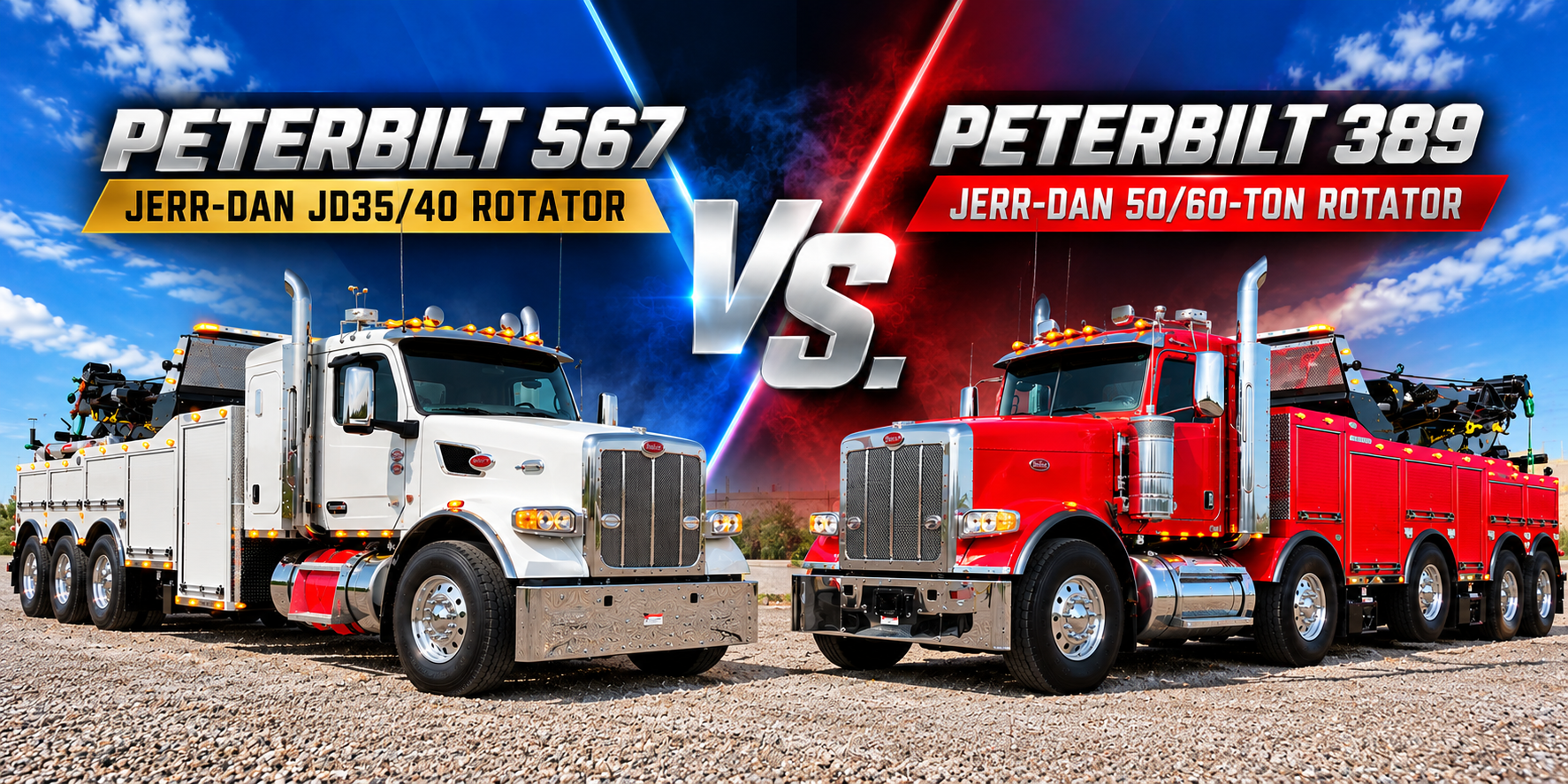
What Makes a Rotator Tow Truck Different?
Unlike conventional heavy-duty wreckers, which typically perform recovery operations primarily from the rear of the truck, a rotator tow truck uses a rotating boom capable of working through a full 360-degree range.
This allows operators to position the truck strategically while performing lifting and recovery operations from the side, rear, or other suitable boom positions.
Rotators are particularly valuable for:
-
Recovering overturned tractor-trailers and commercial trucks.
-
Performing controlled lifts in restricted recovery areas.
-
Recovering heavy vehicles from ditches, embankments, and off-road locations.
-
Assisting with complex accident recovery operations.
-
Lifting and repositioning heavy equipment.
-
Performing recoveries where conventional wreckers cannot achieve a suitable working position.
Although a rotating boom provides considerable flexibility, every lift must remain within the equipment’s rated load chart and stabilization requirements.
Understanding Rotator Tonnage and Lifting Capacity
One of the most important considerations when selecting a rotator tow truck is understanding what its advertised tonnage actually represents.
A 40-ton rotator does not necessarily lift 40 tons at every boom angle or extension. Likewise, a 60-ton rotator cannot lift 60 tons under all operating conditions.
Actual lifting capacity depends on several factors, including boom extension, boom angle, load radius, operating position, outrigger configuration, and the truck’s stability.
For example, Jerr-Dan publishes the following recovery boom specifications for its JD35/40 and JD50/60 rotators:
| Recovery boom specification | JD35/40 | JD50/60 |
|---|---|---|
| Maximum boom length | 37.5 ft | 41 ft |
| Maximum boom angle | 60° | 60° |
| Retracted capacity at 30° | 70,000 lbs | 100,000 lbs |
| Extended capacity at 30° | 19,000 lbs | 20,000 lbs |
| Retracted capacity at 60° | 80,000 lbs | 120,000 lbs |
The comparison illustrates an important distinction: although the larger rotator provides considerably greater lifting capacity with the boom retracted, the difference becomes much smaller at full extension.
For professional recovery operators, evaluating the entire load chart is often more useful than comparing maximum advertised tonnage alone.
When Is a 35/40-Ton Rotator the Right Choice?
A 35/40-ton rotator provides substantial heavy-duty recovery capability while offering the versatility required for a wide range of commercial towing operations.
This class of equipment is well suited for towing businesses that regularly encounter disabled or overturned tractor-trailers, commercial vehicles, buses, and heavy equipment.
Common applications include interstate truck recoveries, controlled lifting operations, accident scene recovery, and heavy-duty towing assignments requiring both a rotating boom and a powerful underlift.
The Jerr-Dan JD35/40 platform features a three-stage recovery boom, continuous 360-degree rotation, and a heavy-duty stabilization system designed to support demanding recovery operations.
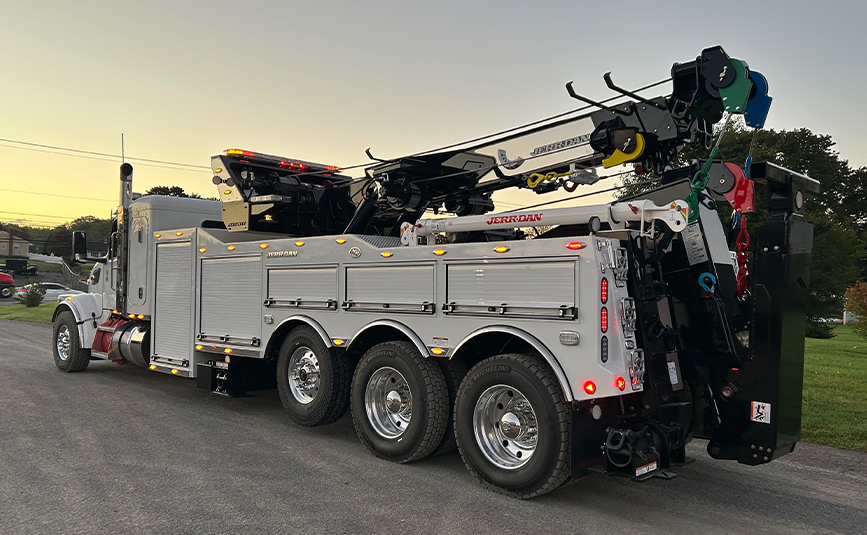
Example: 2027 Peterbilt 567 Jerr-Dan JD35/40 Rotator
Midco Sales offers a 2027 Peterbilt 567 equipped with a Jerr-Dan JD35/40 rotator. This configuration combines heavy-recovery equipment with a Peterbilt chassis designed for demanding commercial applications.
Notable features include:
-
37.5-foot, three-stage rotating recovery boom.
-
Dual 35,000-lb main winches.
-
15,000-lb auxiliary winch.
-
50,000-lb underlift/drag winch.
-
Jerr-Dan 500LP three-stage underlift.
-
Cummins X15 diesel engine rated at 565 horsepower.
-
Allison 4700 RDS-P automatic transmission.
-
44-inch sleeper cab for extended recovery assignments.
The sleeper configuration can be especially useful for operators who travel considerable distances or spend extended periods working at remote recovery locations.
For towing companies seeking a versatile heavy-duty rotator capable of handling substantial recovery assignments, this configuration offers a combination of lifting, winching, towing, and operator accommodations.
When Does a 50/60-Ton Rotator Offer an Advantage?
For towing and recovery companies handling especially demanding commercial vehicle recoveries, a 50/60-ton rotator provides additional lifting capacity and heavy-recovery capability.
These larger rotators can be valuable when dealing with heavy overturned combinations, challenging load positions, or recovery operations that require greater lifting reserves within the manufacturer’s approved load chart.
The Jerr-Dan JD50/60 platform features a larger three-stage recovery boom and a heavy-duty torsion subframe engineered for substantial recovery loads.
Its increased capacity is especially apparent in certain retracted-boom lifting configurations.
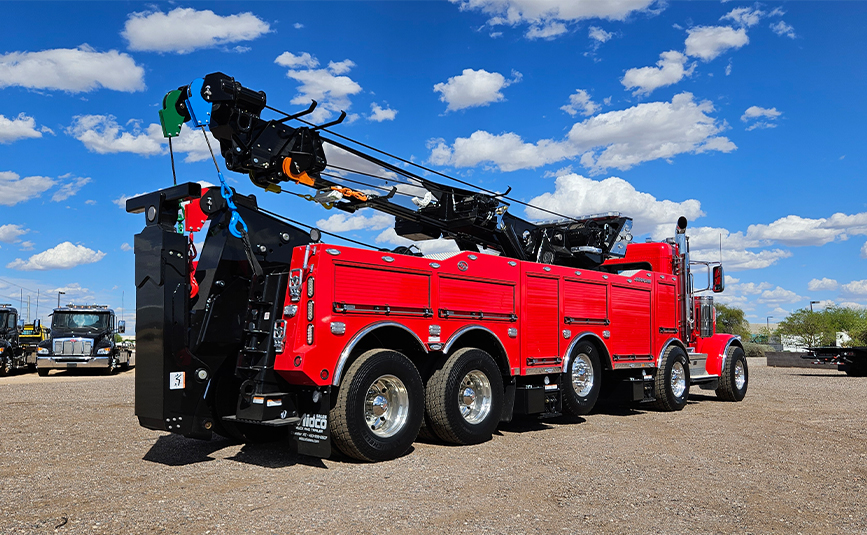
Example: 2024 Peterbilt 389 Jerr-Dan JD50/60 Rotator
Midco Sales also offers a 2024 Peterbilt 389 equipped with a Jerr-Dan JD50/60 heavy-duty rotator.
This truck represents a higher-capacity recovery configuration for operators requiring considerable lifting and winching capability.
Notable equipment includes:
-
41-foot, three-stage rotating recovery boom.
-
100,000-lb retracted lifting capacity at a 30-degree boom angle.
-
120,000-lb retracted lifting capacity at a 60-degree boom angle.
-
Dual 50,000-lb main planetary winches.
-
Dual 20,000-lb auxiliary winches.
-
Heavy-duty recovery boom and stabilization equipment.
-
Peterbilt 389 chassis with Cummins X15 diesel power.
For companies specializing in major highway incidents, commercial vehicle rollovers, and particularly challenging heavy-recovery assignments, the JD50/60 offers additional capacity that may expand the range of operations they can undertake.
However, larger equipment should not automatically be considered the best choice for every recovery business. Fleet requirements, operating costs, maneuverability, and the types of calls a company regularly handles should all influence the purchasing decision.
Why Boom Reach, Outriggers, and Winches Matter
Although lifting capacity receives considerable attention, several other equipment characteristics can be just as important during real-world recovery operations.
Boom Reach and Operating Radius
A rotator’s boom reach determines how far the lifting equipment can extend beyond the truck.
This becomes especially important when recovering vehicles from embankments, working around roadside obstacles, or operating in locations where the recovery truck cannot be positioned directly beside the load.
However, as the boom extends and the load radius increases, lifting capacity generally decreases.
For example, the JD35/40 and JD50/60 both provide three-stage recovery booms, but the larger model offers additional maximum boom length.
The most important consideration is whether the rotator can safely handle the anticipated load at the required working radius—not simply how far its boom can extend.
Outriggers and Stabilization
Heavy-duty rotators rely on substantial stabilization systems to support recovery operations.
Jerr-Dan’s JD35/40 and JD50/60 platforms utilize scissor-style outrigger systems designed to create a wide operating footprint.
Both platforms offer configurations with a 220-inch outrigger spread, while their heavy-duty torsion frames help manage the forces generated during recovery operations.
Proper outrigger placement, ground bearing conditions, cribbing, and manufacturer operating procedures are essential considerations during every recovery.
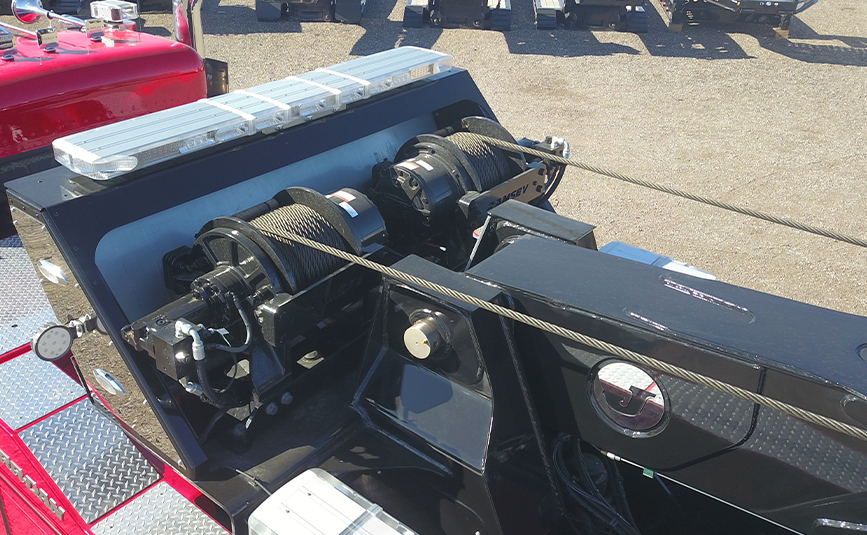
Main and Auxiliary Winches
Winching capability is another important factor when evaluating a heavy-duty rotator.
Main winches provide the pulling force needed for demanding recovery operations, while auxiliary winches can assist with additional rigging, load control, and specialized recovery tasks.
The JD35/40 and JD50/60 configurations available through Midco Sales illustrate these differences.
| Equipment | Peterbilt 567 JD35/40 | Peterbilt 389 JD50/60 |
|---|---|---|
| Main winches | Dual 35,000 lb | Dual 50,000 lb |
| Auxiliary winches | One 15,000 lb | Dual 20,000 lb |
| Recovery boom | 3-stage | 3-stage |
| Rotating boom | 360° | 360° |
Winch ratings should not be confused with the allowable load on the complete recovery system. Wire rope working load limits, rigging components, line configuration, and recovery geometry must all be considered.
Choosing the Right Peterbilt Chassis for Heavy Recovery
The chassis supporting a rotator is another critical part of the equipment selection process.
Heavy-duty recovery trucks must support the weight of the rotator equipment while providing sufficient axle capacity, structural strength, braking capability, and drivetrain performance.
Peterbilt heavy-duty chassis are frequently selected for demanding towing and recovery applications because of their available powertrain and chassis configurations.
The two Midco Sales rotators offer different approaches.
The 2027 Peterbilt 567 features a 565-horsepower Cummins X15 engine, Allison automatic transmission, and 44-inch sleeper cab. This configuration may appeal to companies performing long-distance recoveries or assignments requiring extended periods away from their primary operating location.
The 2024 Peterbilt 389 features a 605-horsepower Cummins X15 engine, Allison automatic transmission, and Peterbilt Ultra Day Cab. Its configuration combines substantial recovery equipment with the distinctive Peterbilt 389 chassis design.
Beyond horsepower, buyers should evaluate axle ratings, wheelbase, suspension, overall dimensions, operating weight, and the specific requirements of their towing territory.
Which Rotator Capacity Is Best for Your Towing Business?
Selecting between a 35/40-ton and 50/60-ton rotator ultimately depends on the types of recovery assignments a company expects to perform.
A 35/40-ton rotator may be an excellent choice for operators requiring versatile heavy-duty lifting, towing, and recovery capabilities without necessarily needing the additional retracted-boom capacity of a larger unit.
A 50/60-ton rotator may be better suited to companies regularly encountering particularly demanding recoveries where greater lifting capacity and winching capability provide a practical advantage.
Before investing in a rotator, towing companies should consider their typical recovery assignments, expected load weights and working radii, local roadway conditions, staffing and operator training, and the potential for expanding into more specialized recovery services.
Neither configuration should be selected solely on its advertised tonnage. A careful review of the manufacturer’s load charts, equipment specifications, and actual operational requirements is essential.
Jerr-Dan Rotator Tow Trucks Available at Midco Sales
Midco Sales is an authorized Jerr-Dan tow truck dealer in Arizona, offering heavy-duty towing and recovery equipment for professional operators.
Our inventory includes Peterbilt-powered Jerr-Dan rotators designed for demanding commercial recovery applications.
Explore our current rotator inventory:
2027 Peterbilt 567 Jerr-Dan JD35/40 Rotator Tow Truck — A versatile heavy-duty rotator featuring a 37.5-foot recovery boom, dual 35,000-lb main winches, sleeper cab, and extensive recovery equipment.
2024 Peterbilt 389 Jerr-Dan JD50/60 Rotator Tow Truck — A higher-capacity heavy-recovery rotator featuring a 41-foot boom, dual 50,000-lb main winches, and Jerr-Dan’s JFB Gold storage package.
Midco Sales offers nationwide delivery, allowing towing and recovery companies throughout the United States to purchase equipment regardless of their location.
For additional information about available Jerr-Dan rotators, equipment specifications, or purchasing options, contact Midco Sales at (480) 999-0607 or visit midcosales.com.


