
When selecting a rollback tow truck, drivetrain configuration can make a significant difference in where and how the truck operates. For towing professionals who encounter unpredictable road conditions, rural service areas, and challenging recovery locations, a 4×4 rollback tow truck offers valuable traction and operational flexibility.
While rollback carriers are commonly associated with transporting disabled vehicles on paved roads, towing operations don’t always take place on ideal surfaces. Gravel roads, muddy shoulders, snowy highways, and construction sites can create situations where four-wheel drive becomes particularly useful.
Understanding the benefits of a 4×4 rollback can help towing companies choose equipment that supports both everyday transport and more demanding roadside assignments.
1. Improved Traction on Loose and Slippery Surfaces
One of the primary advantages of a four-wheel-drive rollback tow truck is improved traction when operating on challenging surfaces.
A 4×4 drivetrain can distribute engine power to both the front and rear axles, helping the truck maintain forward movement when traction is limited.
This can be especially useful when operating on:
- Gravel and unpaved roads
- Muddy or wet ground
- Snow-covered surfaces
- Loose dirt and construction access roads
- Slippery roadside shoulders
For towing operators, having additional traction available can make the difference between accessing a recovery location and needing additional assistance.
However, four-wheel drive does not eliminate the limitations of ground clearance, tire traction, or vehicle weight. Operators must still evaluate conditions before entering unstable terrain.
2. Greater Versatility for Rural Towing Operations
Towing companies serving rural communities often encounter conditions that differ significantly from urban roadside calls.
Vehicles may need to be recovered from agricultural properties, remote driveways, gravel roads, or locations with limited paved access.
A 4×4 rollback tow truck can provide additional flexibility in these environments, particularly when the operator needs to position the carrier on loose or uneven ground.
For businesses serving a mixture of urban and rural customers, four-wheel drive can expand the range of locations where the truck can operate effectively.
This versatility can be particularly valuable for companies that handle both routine vehicle transport and roadside recovery assignments.
3. Better Traction When Carrying a Load
Transporting a vehicle changes the weight distribution and operating characteristics of a rollback tow truck.
When a loaded carrier encounters loose gravel, wet ground, or an inclined surface, available traction becomes especially important.
A properly engaged four-wheel-drive system can help distribute driving force across both axles rather than relying exclusively on the rear axle.
This additional traction may help a loaded rollback maneuver in challenging conditions.
It’s important to understand that four-wheel drive does not increase the truck’s rated payload or carrying capacity. The allowable load remains subject to the chassis GVWR, axle ratings, carrier specifications, and actual weight of the completed truck.
4. Additional Capability in Snow and Winter Weather
For towing businesses operating in areas with seasonal snowfall, a four-wheel-drive rollback can offer practical advantages.
Snow-covered roads, icy access areas, and unplowed driveways can make reaching disabled vehicles difficult.
Four-wheel drive may help improve traction when accelerating or maneuvering on slippery surfaces, particularly when conditions vary throughout a service area.
However, 4×4 does not improve braking performance on ice or eliminate the need for appropriate tires, tire chains where required, and safe driving practices.
For operators who regularly encounter winter conditions, four-wheel drive can be an important part of a properly equipped towing vehicle.
5. Improved Access to Construction Sites and Equipment Locations
Rollback tow trucks aren’t limited to transporting passenger vehicles.
Depending on their rated capacity and configuration, carriers may also be used to transport compatible compact equipment, utility vehicles, and work machinery.
Construction sites frequently feature gravel access roads, loose soil, and unfinished surfaces.
A 4×4 rollback may provide an advantage when entering these areas to load or unload equipment.
The combination of four-wheel-drive traction and a properly equipped rollback body can make these trucks useful for businesses handling a variety of vehicle and equipment transport assignments.
Operators should always verify that the equipment’s weight, dimensions, and loading requirements are compatible with the truck and carrier.
6. Added Flexibility for Roadside Recovery Work
Not every disabled vehicle is conveniently located on level pavement.
Towing operators may encounter vehicles on gravel shoulders, uneven driveways, rural access roads, or other difficult surfaces.
Four-wheel drive can help the rollback reach suitable positioning areas and maneuver when traction is limited.
When combined with a properly rated winch and recovery equipment, a 4×4 carrier can be a versatile tool for many roadside assignments.
However, the truck’s drivetrain should never be treated as a substitute for proper recovery techniques. Winch ratings, anchor points, ground conditions, and vehicle stability must all be considered before attempting a recovery.
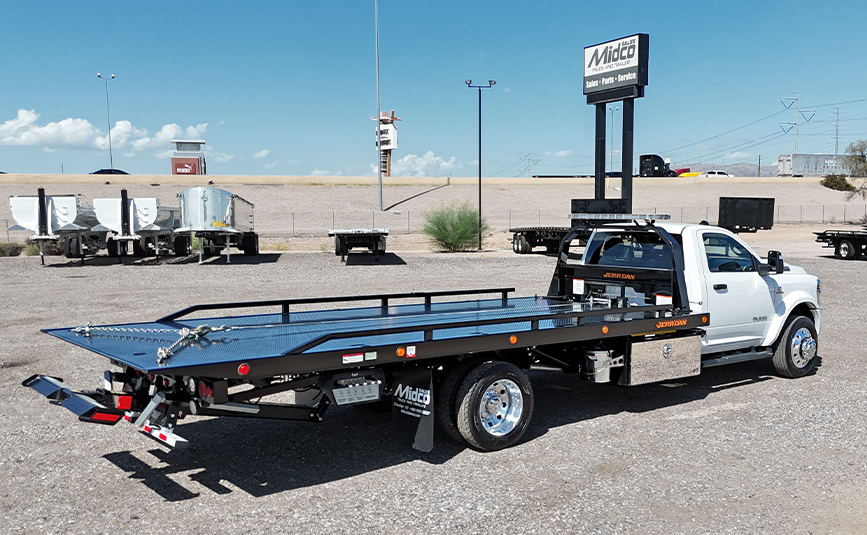
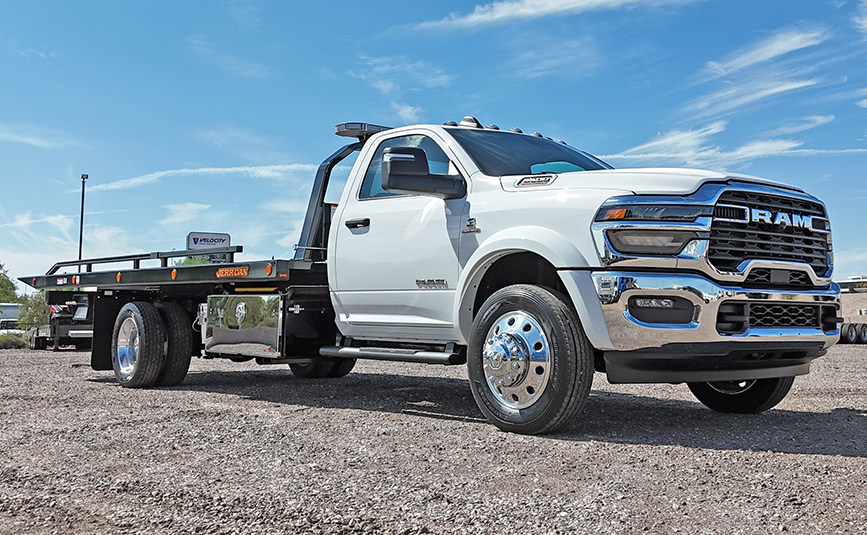
Featured 4×4 Rollback: 2026 RAM 5500 Big Horn Jerr-Dan
For operators considering a four-wheel-drive carrier, the 2026 RAM 5500 Big Horn 4×4 Jerr-Dan rollback available at Midco Sales is an example of a professionally equipped towing platform.
Built on a RAM 5500 4×4 commercial chassis with a 6.7L Cummins Turbo Diesel engine, this truck combines four-wheel-drive capability with a Jerr-Dan 6-ton steel rollback body.
Notable equipment includes:
- 20-foot Jerr-Dan steel rollback deck
- 7.5-degree loading angle
- Ramsey 10,000-pound worm-gear winch
- Integrated wheel lift rated for 3,500 pounds of lift and 10,000 pounds of towing
- Dual rear-view cameras for the carrier deck and wheel lift
- Lockable toolboxes, onboard air compressor, and roadside recovery accessories
This combination provides towing operators with a well-equipped carrier for routine transport and a range of roadside applications.


