
What is a Belly Dump Trailer
-
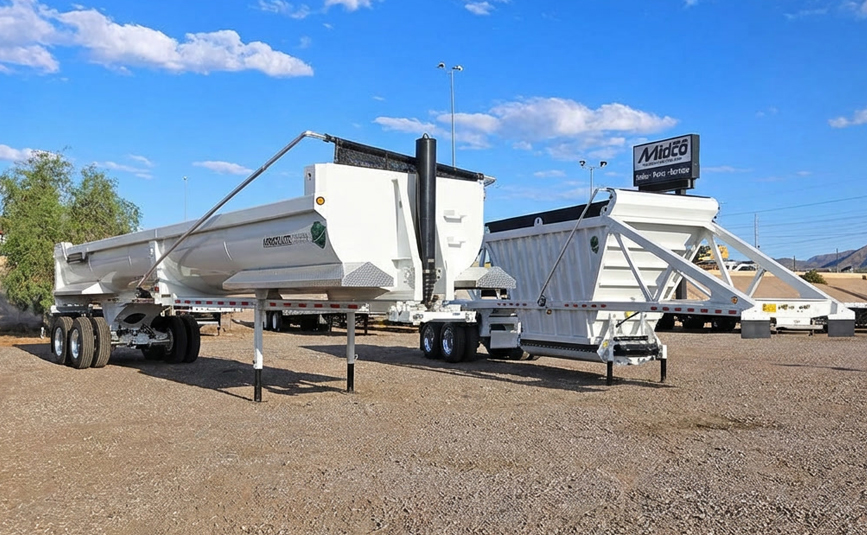
A belly dump trailer — also known as a bottom dump trailer — unloads materials through a clamshell-type gate on the underside (the “belly”) of the trailer rather than tipping the whole bed.
-
Because the dump bed doesn’t raise, the trailer remains relatively stable during unloading, which reduces tip-over risk.
-
The unloading method allows for “windrowing” — depositing material in long, controlled lines rather than dumping into a pile. This makes belly dumps especially useful when you need to lay down an even spread of material rather than a single heap.

Common Uses
Belly dump trailers are widely used in applications such as:
-
Road construction and paving — for distributing gravel, road base, or asphalt evenly.
-
Hauling aggregate materials like gravel, sand — especially when the job demands a controlled spread rather than a big pile. (And yes — your own inventory page for belly dump trailers from Midco Sales is a go-to for those materials.)
Limitations
Because of how they unload:
-
Belly dump trailers are typically not well-suited for hauling liquids or very fine material that may leak out of the bottom gate.
-
Materials that are large, irregularly shaped, or bulky may hang up on suspension components or struggle to exit smoothly.
What is an End Dump Trailer
-
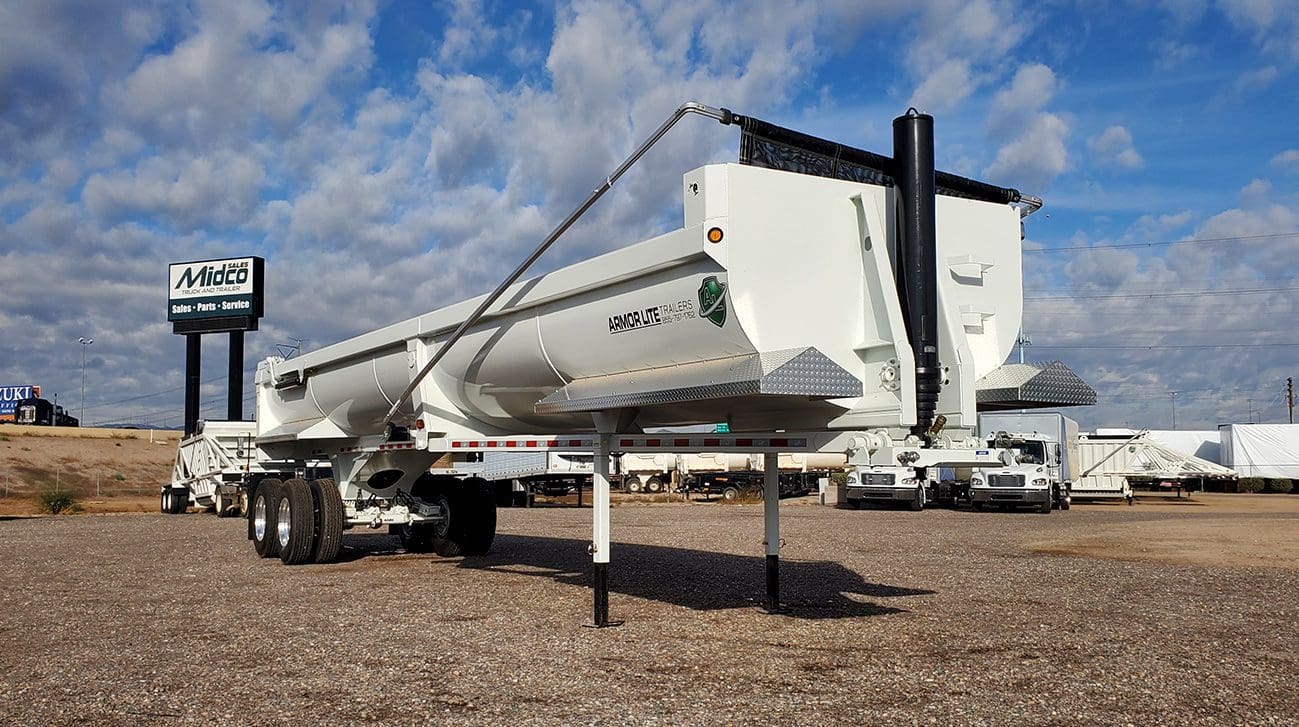
An end dump trailer (also “dump trailer” or “semi end dump”) unloads by lifting the front of the trailer bed via hydraulics, causing materials to slide out the rear of the trailer.
-
End dump trailers tend to have higher sidewalls than belly or side dumps — which allows for more cubic volume and higher capacity per load.
Common Uses
End dump trailers are a go-to for:
-
Major construction or demolition projects: hauling rock, gravel, rubble, demolition debris, asphalt, or other bulk materials.
-
Applications where you need to move large loads in a single haul — because of their higher capacity compared to belly dumps.
Limitations / Considerations
-
Because the bed must be raised to dump — and the load shifts while dumping — end dumps are more prone to instability, especially if the unloading area is uneven or soft.
-
They typically don’t handle liquids well, because the rear gate is not easily made watertight and contents may leak.
Belly Dump vs End Dump — Head-to-Head Comparison
| Feature / Consideration | Belly Dump Trailer | End Dump Trailer |
|---|---|---|
| Unloading Method | Bottom gate — material drops downward in a controlled, continuous flow (windrow) | Bed lifts hydraulically and unloads from rear, dumping into a pile |
| Typical Materials | Aggregates like gravel, sand, road-base — best for materials that spread evenly | Heavy materials: gravel, rock, demolition debris, asphalt, etc. Bulk loads requiring high capacity |
| Load Capacity / Volume | Good — but sometimes limited due to gate clearance & bottom-dump design | Often higher capacity per load due to taller sidewalls |
| Unloading Control | High — can windrow material precisely, useful for paving or spread projects | Less controlled — dumps as a pile, requiring loader or spreader to distribute |
| Stability During Dumping | Generally more stable — no tipping of bed required | Less stable — risk of tip/rollover on uneven ground due to bed raise |
| Material Limitations | Not ideal for liquids or very fine material (leak risk), or oversized/bulky loads that might jam when bottom-dumping | Not ideal for wet/slurry loads (gate sealing issues), may be risky on soft or uneven ground |
| Use-Case Strengths | Road paving, base layer distribution, controlled spread of aggregates | Large-volume hauling, heavy materials, demolition cleanup, general bulk transport |
Which Trailer Should You Choose? (When to Use Which)
-
Choose a belly dump trailer if your work involves road construction, paving, spread work, or projects needing a controlled, even distribution of aggregate or road-base materials. The ability to windrow makes belly dumps a go-to for paving crews or base-layer contractors.
-
Choose an end dump trailer when you need volume and versatility — for general hauling of heavy or bulk materials (rock, gravel, demo debris, asphalt), or when you’re transporting loads where spreading is not required.
In short: if the job demands precision spreading and smooth unloading — go belly dump. If you’re hauling big loads from A to B — go end dump.
Why This Matters for You (as a Buyer/Operator) & How Midco Sales Can Help
At Midco Sales, we offer a full line of both belly dump and end dump trailers, including Armor Lite trailers:
-
Check out our Belly Dump Inventory for trailers ideal for asphalt, road-base, gravel, sand, and other spread-type jobs.
-
Explore our End Dump Inventory for steel or aluminum trailers built to haul heavy aggregates, demolition debris, and general bulk materials across construction, roadwork, landscaping, or aggregate delivery jobs.
Choosing the right trailer type for your project can improve efficiency, reduce labor (spreading vs. piling vs. loader work), lower risk (especially avoiding tip-overs), and increase job-site safety.
If you’re unsure which trailer makes the most sense for your operation — or you want a spec-by-spec recommendation (payload, axle configuration, material type, hauling distances, job-site conditions) — contact our sales team. We’ll help match you with the right trailer to fit your fleet and workload.
Midco Sales
1200 S. Akimel Ln. (map)
Chandler, AZ 85226
(480) 999-0607
Bottom Line
Belly dump and end dump trailers both move aggregate and bulk materials — but they excel at different tasks. Belly dumps are the smart choice when you need controlled spreading and job-site precision. End dumps shine when you need bulk hauling capacity, versatility, and volume. Choosing the right one for your needs will make the difference between a smooth job-site and avoidable downtime or inefficiency.


